Updated November 2026
For more than three and a half centuries, the Tonnara Saline in Stintino was the economic heart of this stretch of coast. Every spring, just off the Saline tower, a huge barrier of nets was lowered into the sea to catch Atlantic bluefin tuna on their migration. The earliest records date from the early 1600s, and the tuna fishery finally stopped in the 1970s.
For us, fishing every day in the Gulf of Asinara, this isn’t distant history. The village we sail from grew up partly thanks to the tonnara, and many of the words we still use on board come from that world. In this guide we explain how a fixed tuna trap worked, who the rais and the tonnarotti were, what the mattanza was, why the tonnara closed and what you can see today at the Tuna Fishery Museum in Stintino.
We’ve relied on official sources such as the Municipality of Stintino and the museum itself; where they don’t agree, we say so.
At a glance
- Where: the tonnara fished off the Saline area, south of the village; the processing plant stood next to the tower of the same name.
- When: the first known document dates from 1602; processing stopped in the 1960s and fishing for good in the 1970s.
- How: a fixed tuna trap, an “island” of nets divided into chambers, led by the rais and worked by the tonnarotti.
- Today: its story is told at the MuT, Museo della Tonnara, which opened in 2016 on Via Lepanto in Stintino.

What was the Tonnara Saline in Stintino?
A fixed tuna trap (tonnara fissa) isn’t a boat or a building. It’s a fishing installation made of nets, cables, anchors and floats, lowered into the sea at the same spot every year and taken apart at the end of the season. Ashore stood the plant where the tuna was processed and preserved, with storerooms for the nets and boats.
The Tuna Fishery Museum describes the Saline trap as a true “building in the water”, made up of six connected chambers. The plant stood near the Torre delle Saline, one of the coastal watchtowers built under Spanish rule to guard this coast. The area takes its name from the salt pans, worked as early as the Middle Ages and still in use in the early twentieth century.
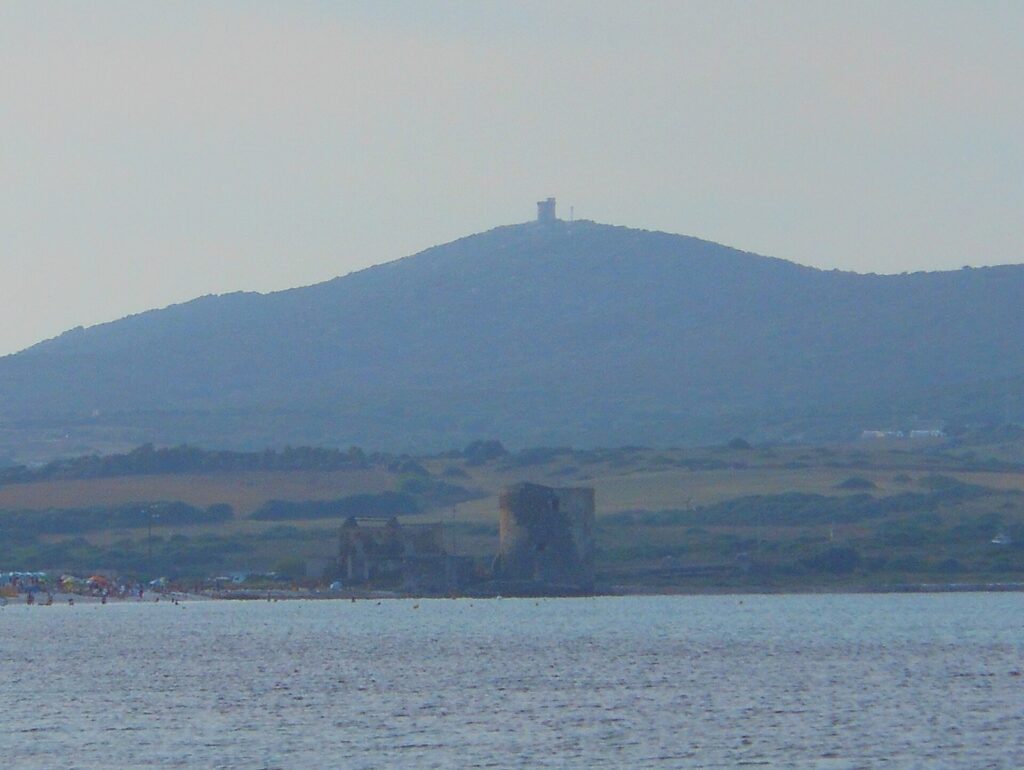
According to the Municipality, the history of Stintino and the history of the tonnara are inseparable. Like every large tuna fishery, it gave work to dozens of men for months at a time and kept a whole economy going: boats, nets, rope, carpenters and merchants.
The history of the Tonnara Saline: from the 1500s to the 1970s
Tuna fishing in Sardinia goes back a very long way. The museum recalls that in 1587 Pietro Porta, a merchant from Cagliari, was granted permission by King Philip II to set the first tuna traps along the island’s west coast, and the Saline was one of them. Even the title of the head fisherman, rais, comes from Arabic and means “chief”.
The first document about the Tonnara Saline, according to the Municipality of Stintino, dates from 1602 and is kept in the Archive of the Crown of Aragon in Barcelona. The first production figures, reported by the historian Salvatore Rubino, are from 1604: that year 2,097 barrels of tuna were packed.
Owners and managers: the key changes
Over the centuries the tonnara changed hands several times. These are the main milestones according to the Municipality and the museum.
| Year | What happened |
|---|---|
| 1587 | Pietro Porta is granted permission by Philip II for the first tuna traps on Sardinia’s west coast, including the Saline |
| 1602 | First known document on the Tonnara Saline (Archive of the Crown of Aragon) |
| 1604 | First production figures: 2,097 barrels of tuna packed |
| 1654 | The nobleman Gerolamo Vivaldi buys the tonnara; his family leases it to various businessmen |
| 1868 | The Anfossi, Pretto and Biggio families take over the concession and later buy the tonnara |
| 1885 | Stintino is founded: families leave Asinara and settle near the tonnara |
| 1900–1949 | The tonnara is run by Antonio Penco |
| 1949–1969 | He is succeeded by his grandson, Italo Penco |
| 1964 | The processing plant closes; for the museum, the year of the last “real” mattanza |
| 1969–1970 | A new company puts the trap back in the sea; in 1970 Agostino Diana becomes rais |
| 1970s | Final closure; the buildings are sold to cover debts |
| 1997 | The trap is set once more, led by Agostino Diana |
| 2016 | The MuT, Stintino’s Tuna Fishery Museum, opens |
The sources don’t fully agree on the final dates. The museum gives 1964 as the year of the last “authentic” mattanza. The Municipality explains that in 1969 the tonnara was revived by a company formed by the Anfossi family and the lawyer Salvatore Greco, and that it closed for good in the 1970s after a few unproductive seasons. The Monumenti Aperti material on Stintino says the plant worked until 1964 and the tonnarotti were at sea until 1973.
From Asinara to Stintino: the families of 1885 and the tonnara
The link between the village and the tuna fishery predates Stintino itself. In the first half of the nineteenth century, fishermen from Camogli in Liguria were living at Cala d’Oliva on Asinara. According to the historical account published by the Municipality, they had been drawn there partly by the Saline tuna fishery on the opposite coast.
In 1885 the Italian state decided to set up a quarantine station at Cala Reale and an agricultural penal colony on Asinara. The islanders had to leave: 45 families, Ligurian-born fishermen and Sardinian shepherds, founded a new village on the coast between two inlets called “Isthintini”. While their houses were being built, they found shelter and work near the old Tonnara Saline plant. Being close to the tonnara, the Municipality notes, was probably one of the main reasons they chose the spot.
We tell these stories in our pages on the history of Stintino and the history of Asinara. You’ll find the village of Cala d’Oliva in our guide to Cala d’Oliva and the bunker.
How a fixed tuna trap worked
The fixed tuna trap made use of a very specific habit of the bluefin tuna. In spring, large shoals enter the Mediterranean from the Atlantic and follow the coast towards their spawning grounds. Across their route, a long barrier of nets was set to steer them towards the island, the enclosure of nets anchored to the seabed.
The island was divided into connected chambers, separated by nets that could be opened and closed. The tuna moved from one chamber to the next until they reached the last one, the chamber of death, the only one with a net on the bottom as well. That’s where the mattanza took place.
The season: setting, fishing and lifting
The work began on land, preparing nets, anchors and boats. In Mediterranean tuna fisheries, the trap was usually set in early May, as the tuna came through. At the end of the season everything was hauled out, repaired and stored for the following year.
The rais and the tonnarotti
The rais was the undisputed head of the tonnara. He chose where to set the trap and decided when to open the chambers and start the mattanza. He had to know the seabed, the currents, the weather and the habits of the tuna. During the mattanza he gave orders from his boat, the muciara.
The tonnarotti were the crew. They set and watched the nets, handled the boats, repaired the gear and worked the mattanza. Many started as boys and learned the trade from the older men, season after season.
The last rais of the Tonnara Saline was Agostino Diana. A tonnarotto since boyhood, he was appointed rais in 1970 by Beppe Anfossi, the owner of the tonnara. In 1994 he helped create the first tuna fishery museum, “Il ricordo della memoria”, and in 1997 he led the new setting of the trap. He died in November 2024, aged 90, and the new museum was designed around his figure.
The mattanza
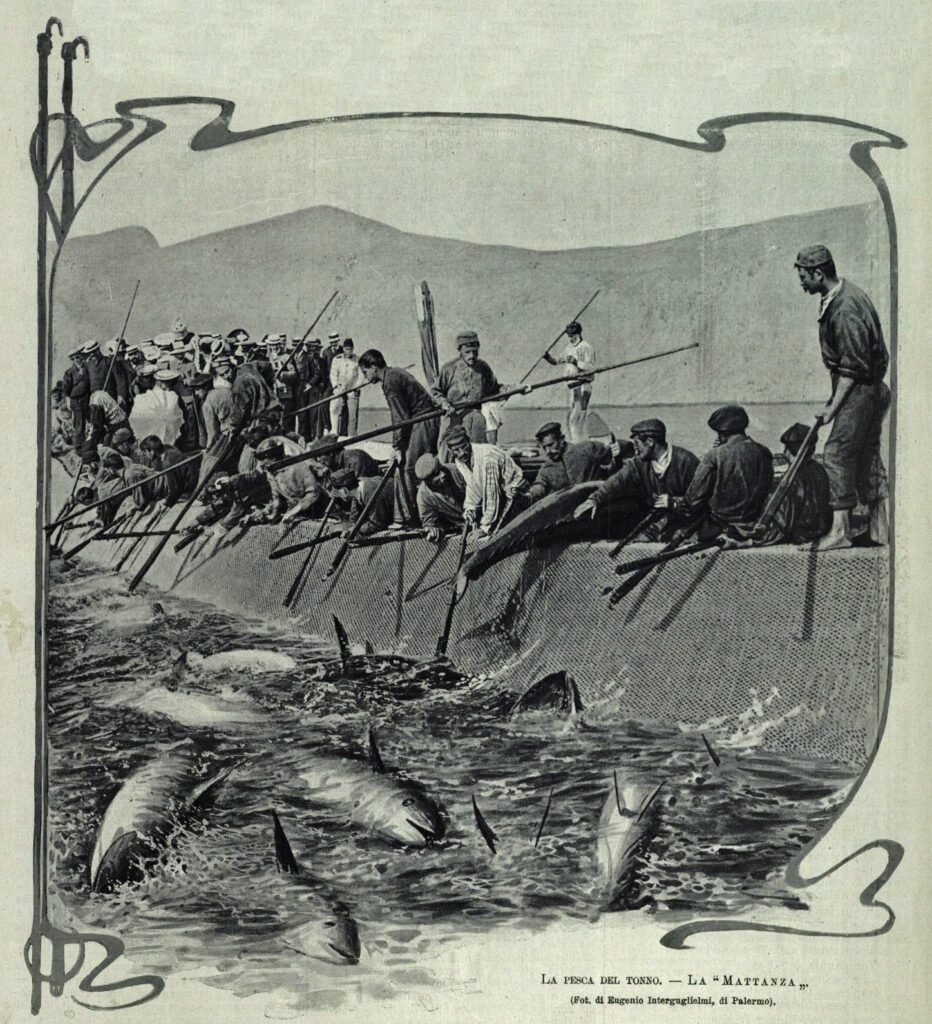
When there were enough tuna in the chamber of death, the rais gave the signal. The boats lined up around the chamber and the tonnarotti began hauling up the bottom net by hand. The space grew tighter, the tuna rose to the surface and were hoisted aboard with hooks.
It was gruelling, dangerous work that demanded strength and coordination, paced by the rais’s commands: short, firm orders that everyone carried out together. Today it can be shocking, and it’s right to see it for what it was: a livelihood for whole communities, governed by rituals, hierarchies and strict rules, at a time when tuna was one of the few riches the sea offered.
The language of the tonnara: a short glossary
Here are the main terms, many of them still used by people who work at sea.
| Term | Meaning |
|---|---|
| Rais | The head of the tonnara, in charge of the fishing and the men. The word comes from Arabic and means “chief”. |
| Tonnarotti | The crew who set, watched and lifted the trap and worked the mattanza. |
| Isola (island) | The large enclosure of nets anchored to the seabed, divided into chambers. |
| Camere (chambers) | The compartments of the island. For Stintino, the Sardinia tourism board lists camera grande, bordonarello, bordonaro, camera bastardo, camera di ponente and camera della morte. |
| Camera della morte | The “chamber of death”: the last chamber, the only one also closed at the bottom, where the mattanza took place. |
| Muciara | The boat from which the rais directed operations. |
| Calata | Setting the nets, cables and anchors at the start of the season. |
| Salpamento | Lifting the whole installation at the end of the season. |
| Mattanza | The final stage of the fishing, when the bottom net of the chamber of death was raised and the tuna caught. |
Why the Tonnara Saline closed
In the twentieth century, the crisis of fixed tuna traps hit the whole Mediterranean. The causes most often cited are falling tuna stocks, pollution and industrial fishing, which intercepts the shoals out at sea before they reach the coast. For an installation that waits for the fish in the same place every year, that meant ever poorer seasons.
In Stintino the ending was bitter. According to the Municipality, after the last unproductive seasons the buildings were sold to clear the debts. In 1997 a group of businessmen and young people from the village decided to try again, and the trap went back into the sea under Agostino Diana: a return that shows how deeply this story is still felt.
The Tuna Fishery Museum in Stintino (MuT): what to see
The MuT, Museo della Tonnara di Stintino, opened on 18 June 2016 on Via Lepanto, in the former ALPI plant. It grew out of the work of Salvatore Rubino and Esmeralda Ughi of the Centro Studi sulla Civiltà del Mare, and it tells the story of traditional tuna fishing in the Gulf of Asinara and the lives of the people who did it. It’s the place to go to understand the history of Stintino’s tonnara.
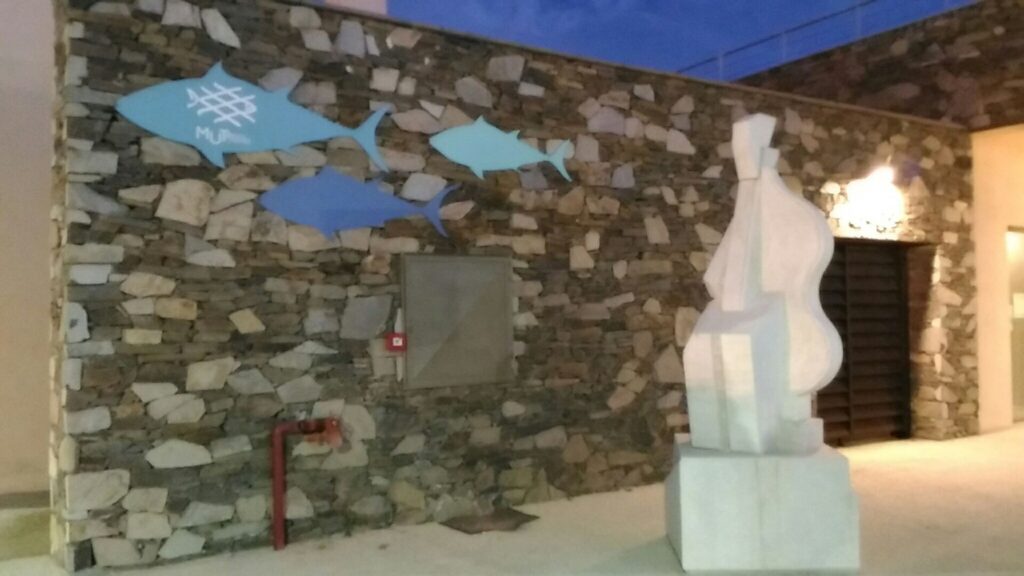
Inside you’ll find:
- the tools used in the tonnara;
- documents, diaries and old newspaper articles;
- the clothes worn during the mattanza;
- models of the boats and the net installation;
- works by Sardinian artists depicting the tonnara;
- videos narrated in Italian with English subtitles.
Opening times change with the season, with evening openings in summer, and the museum offers guided tours in Italian and, on request, in English. Opening hours, tickets and current exhibitions are on the official Tuna Fishery Museum website: check them before you go. There are other places in the village linked to this story, and you’ll find them in our guide to what to see in Stintino.
Silvia’s tip
Visit the museum on a windy day, when the sea isn’t at its best, or on a summer evening. Then walk down to the Saline tower: looking out to sea with everything you’ve just learned fresh in your mind, it’s much easier to picture where the trap was set.
From tuna to bottarga: the legacy on the table and in the village
The tonnara wasn’t only about fishing. The tuna was processed ashore and preserved to be sold far away: as early as 1604, as we’ve seen, barrels were being counted. That economy left behind a fish culture you can still feel in Stintino.
Among the village’s dishes, Sardinia’s tourism board mentions tuna bottarga (salted, dried roe), alongside octopus in agliata or Stintino-style and lobster soup. If you’d like to try the local cooking, you’ll find some ideas in our guide to where to eat in Stintino.
You can see the legacy in the streets too. A large mural in the village depicts the mattanza: tonnarotti bent over the nets and tuna breaking the surface. The same tourism board page suggests July as a good time to visit the museum, during the tuna festival: dates and programme change every year, so check the events calendar.
Bluefin tuna today: protection and quotas
Eastern Atlantic and Mediterranean bluefin tuna is now subject to very strict rules. It’s managed by ICCAT, the International Commission for the Conservation of Atlantic Tunas, which since 2018 has applied a multi-year management plan, introduced by Recommendation 18-02 and also adopted by the European Union.
In short: each year a catch limit is set and divided into quotas between countries. Italy shares out its quota among the different fishing methods, including fixed tuna traps, which must be authorised and entered in an ICCAT register. There are also catch controls and a documentation system that follows each tuna all the way to sale.
If you want to see a mattanza in Sardinia today, you’ll need to head to the south-west, where a few fixed traps still operate: according to the Sardinia tourism board, those at Isola Piana near Carloforte and Su Pranu at Portoscuso are set every year between May and June. In Stintino, the tonnara now lives on in memory, in the museum and in the words of those who go to sea.
The tonnara and our trade today
We don’t fish for tuna. Ours is small-scale fishing with pots: we set them in the evening, haul them in the morning with our guests on board, and undersized fish go straight back into the sea. But respect for the sea and its rhythms, which the tonnarotti knew so well, is exactly what we try to pass on aboard.
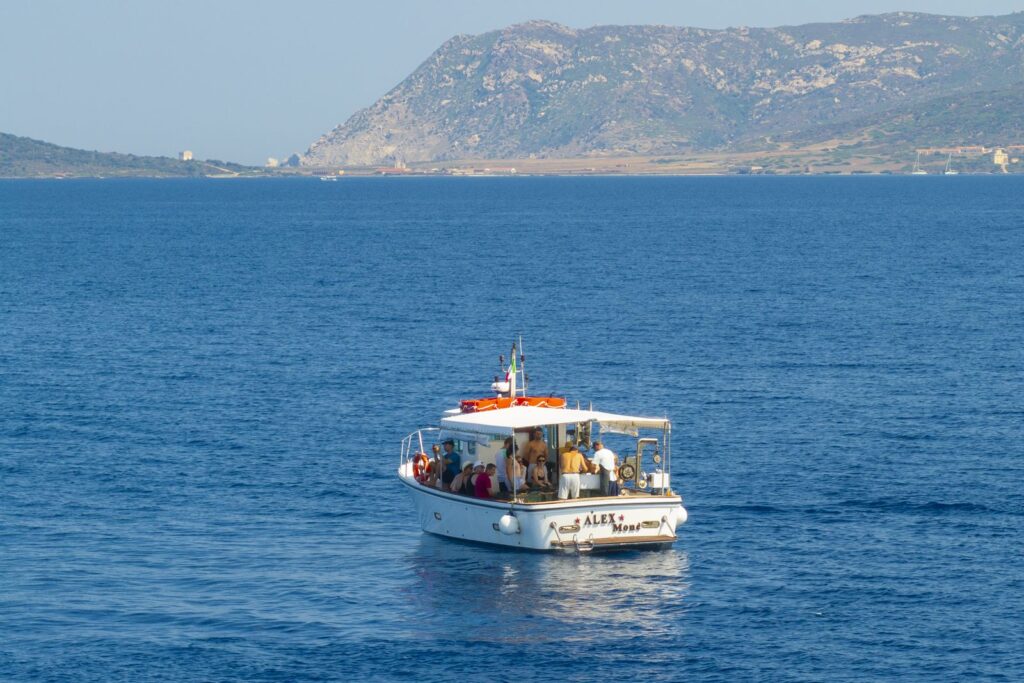
On board we often tell this story as we sail through the gulf where the trap was set for centuries. If you’d like to understand what a real fishing day looks like, read what fishing tourism is. If you’re planning your trip, our guides on how to visit Asinara and the beaches of Stintino may also help.

Tonnara Saline in Stintino: FAQ
When did the Tonnara Saline in Stintino close?
The processing plant stopped in 1964, the year the museum gives for the last real mattanza. Fishing resumed in 1969 and ended for good in the 1970s; in 1997 the trap was set once more.
Can you still see a mattanza in Stintino?
No, the tonnara in Stintino is no longer active. In Sardinia, the fixed tuna traps still in use are in the Sulcis area, at Carloforte and Portoscuso, between May and June.
Where is the Tuna Fishery Museum in Stintino?
The MuT is on Via Lepanto in Stintino, in the former ALPI plant. Opening hours and tickets change with the season and are published on the museum’s official website.
Who was the rais of the tonnara?
He was the head of the tonnara: he decided where to set the nets, when to open the chambers and when to start the mattanza. The last rais of the Tonnara Saline was Agostino Diana, appointed in 1970.
What is the chamber of death?
It’s the last chamber of the trap, the only one closed at the bottom by a net. By raising that net, the tuna were brought to the surface during the mattanza.
How is the tonnara linked to the founding of Stintino?
In 1885 the families moved off Asinara settled near the Tonnara Saline, where they found shelter and work. According to the Municipality, the tonnara was probably one of the main reasons they chose the site.
Want to get to know the sea of the tonnara up close? Come aboard the fishing boat Alex with Davide and Silvia: real pot fishing in the Gulf of Asinara, stories of our sea and lunch with the catch of the day → book your day.